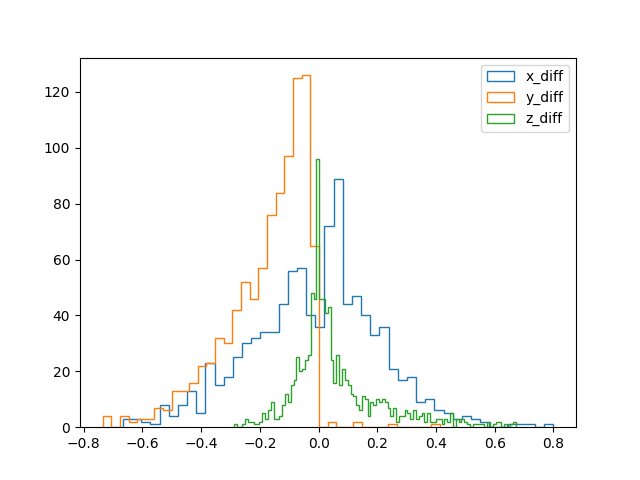
The python code used for testing:
import numpy as np
import matplotlib.pyplot as plt

eV = 1e-6   #geant const

#surface normal
theFacetNormal = np.array([0,0,1])

#value found during debugging for Au->vacuum
energyThreshold = 5 * eV


#energy of electron
ekint = 6 * eV


N = int(1e5)
phi = np.random.sample(N)*2*np.pi
theta = np.random.sample(N)*np.pi/2

in_arr = np.stack((np.cos(phi)*np.sin(theta), np.sin(phi)*np.sin(theta), -np.cos(theta))).T
# in_arr = np.random.sample((3,N)).T*2 - 1

# %%
def orthogonal(vec):
    """
    inline Hep3Vector Hep3Vector::orthogonal() const {
      double xx = x() < 0.0 ? -x() : x();
      double yy = y() < 0.0 ? -y() : y();
      double zz = z() < 0.0 ? -z() : z();
      if (xx < yy) {
        return xx < zz ? Hep3Vector(0,z(),-y()) : Hep3Vector(y(),-x(),0);
      }else{
        return yy < zz ? Hep3Vector(-z(),0,x()) : Hep3Vector(y(),-x(),0);
      }
    }
    """

    x = vec[0]
    y = vec[1]
    z = vec[2]

    # return np.array((-1,-1,-1))
    # res = np.cross(vec, np.random.sample(3))

    if abs(x) < abs(y):
        if abs(x) < abs(z):
            res =  np.array([0, z, -y])
        else:
            return np.array([y, -x, 0])
    else:
        if abs(y) < abs(z):
            res = np.array([-z, 0, x])
        else:
            res = np.array([y, -x, 0])

    return res/np.linalg.norm(res)

# %%

out_arr = np.zeros((len(in_arr), 3))
for i, incoming in enumerate(in_arr):
    # incoming[-1] = -1
    #momentum of electron - unit vector
    incoming = np.array(incoming)
    incoming = incoming / np.linalg.norm(incoming)

    #supporting method from G4MicroelecSurface
    def GetIncidentAngle(oldMomentum):
        PdotN = np.dot(oldMomentum, theFacetNormal)
        magP = np.linalg.norm(oldMomentum)
        magN = np.linalg.norm(theFacetNormal)

        incidentangle = np.asin(PdotN/(magP*magN))
        # incidentangle = np.acos(PdotN/(magP*magN))
        # incidentangle =
        return incidentangle

    #a ted uz hura na ty vypocty
    thetat = GetIncidentAngle(incoming)  #angle d incidence

    thetat_alt = np.atan(incoming[2]/np.sqrt(incoming[0]**2 + incoming[1]**2))
    # print(f"{incoming}")
    # print(f"{thetat = } rad")
    # print(f"{thetat_alt = } rad\n")
    ekinNormalt = ekint * np.cos(thetat)**2

    sin_thetaft = np.sqrt(ekint/(ekint+energyThreshold)) * np.sin(thetat)
    #Refraction angle
    if (1.0-sin_thetaft**2 ) > 0:
        cos_thetaft = np.sqrt(1.0-sin_thetaft**2);
    else:
        cos_thetaft = 0.0;

    # print(cos_thetaft)
    #finalni vypocet
    cos_thetaft = cos_thetaft*np.cos(thetat) + sin_thetaft*np.sin(thetat)

    zVerst = incoming
    xVerst = orthogonal(zVerst)       #zVerst.orthogonal()
    yVerst = np.cross(zVerst,xVerst)

    xDirt = np.sqrt(1. - cos_thetaft**2);
    yDirt = xDirt;

    zPrimeVerst=((xDirt*xVerst + yDirt*yVerst + cos_thetaft*zVerst));

    #aParticleChange.ProposeMomentumDirection(zPrimeVerst.unit());
    #->unit

    unitVecResult =  zPrimeVerst / np.linalg.norm(zPrimeVerst)

    out_arr[i] = unitVecResult
    # print(f" in: {incoming} \nout: {unitVecResult} \n")


out_arr = out_arr.T
in_arr = in_arr.T
# %%

fig, ax = plt.subplots()
for x, d in zip(in_arr, ("x_in", "y_in", "z_in")):
# for x, d in zip(in_arr.T, ("x", "y", "z")):
    ax. hist(x,
             label = d,
             bins = 50,
             histtype = "step"
             )
ax.legend()

fig, ax = plt.subplots()
for x, d in zip(out_arr, ("x", "y", "z")):
# for x, d in zip(in_arr.T, ("x", "y", "z")):
    ax. hist(x,
             label = d,
             bins = 50,
             histtype = "step"
             )
ax.legend()

diff_arr = out_arr - in_arr
fig, ax = plt.subplots()
for x, d in zip(diff_arr, ("x_diff", "y_diff", "z_diff")):
# for x, d in zip(in_arr.T, ("x", "y", "z")):
    ax. hist(x,
             label = d,
             bins = 50,
             histtype = "step"
             )
ax.legend()

fig, ax = plt.subplots()
r = np.sqrt(out_arr[0]**2 + out_arr[1]**2)

out_phi = np.atan2(out_arr[1],out_arr[0])
# out_phi = np.asin(out_arr[1]/r)
# out_phi = np.arccos(out_arr[0]/r)
out_theta = np.arctan(out_arr[2]/r)

for d, name in zip((
        out_phi,
        out_theta
        ), (
            "phi",
            "theta"
            )):
    ax.hist(d,
            bins = 70,
            label = name,
            histtype = "step"
            )

ax.legend()