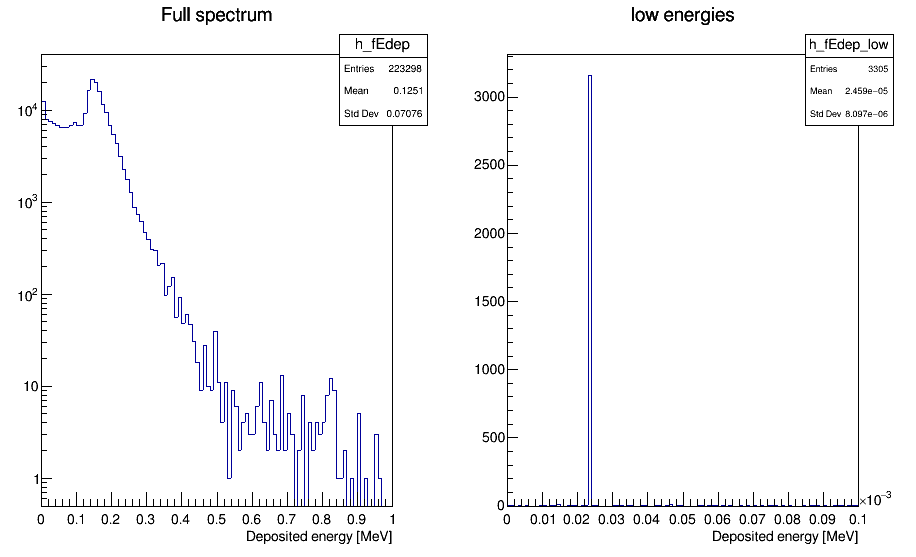
I am propagating cosmic rays (from CRY) into some surrounding material measuring the energy deposited in He3.
For very low energies, I get a spike at exactly 23.42 eV usually deposited by gamma in a Compton scattering process (or in transportation).
In some cases is a daughter gamma, from an electron parent, carrying the whole 23.42 eV of kinetic energy.
I see a similar peak if shooting as primaries gammas, electrons or some other isotopes.
Is there any particular physics phenomenon I am missing at that particular energy? apparently Helium first ionization is 24.5 eV which is not miles away.
I am a bit puzzled by this. In principle it could be K_alpha from He? (Although this fluorescence should be largely below threshold). Which physics list and which settings/cut are you using? Can you determine which kind of particle carries 23.42 eV and which is the generator process?
thanks for the answer.
Yes is slightly below the ionization threshold.
It is usually a gamma and the GetPreStepPoint()->GetProcessDefinedStep()->GetProcessName() is most of the time a Compton; the physics lists are:
in principle the G4LivemoreComptonModel will try to produce fluorescence, following the electron vacancy which is left in the target atom after the Compton Scattering. However, I am not sure of how the AtomicDeexcitationManager handles the He case… Just to be sure, could you please disable the atomic deexcitation via /process/em/fluo false
and/or avoid the production of sub-threshold secondaries: /process/em/deexcitationIgnoreCut false
Do I need to write my own physics list builder, wrapping G4EmLivermorePhysics to turn off those 2 parameters? Or there is another way for doing that? Right now I have a physics.cc like this
you don’t need a wrapper, you can change the settings directly from the C++ code, using the G4EmParameters, just the way you wrote below. You can even do that in the main(), after you feed the physics list to the RunManager.
Ok, this means that the energy deposit is not due to real secondary tracks, but to the Compton model itself. Could you please check if the structure disappears by using a different EM constructor (e.g. G4EmStandardPhysics_opt3 or G4EmPenelopePhysics) ?
Also, what’s the primary gamma energy we are talking about?
I don’t remember exactly the issue here, since it was pretty old, but I confirm that, according to the pdatconf.p08 database, the ionization energy of He is 24.59 eV. This file is imported directly in Geant4 and used by the G4Penelope models.
apparently the issue still stands that’s why I came back to this thread. We were arguing if that deposition was physical or not, but most likely not since independent from the fluorescence flag and peaking exactly close to the ionisation energy of the helium shell electron.
Ok, I need to get back to the entire thread. This peak of deposited energy is produced by G4PenelopeComptonModel, upon a high-energy gamma Compton scattering? I assume this is the de-excitation energy of the He atom, as the K-shell electron is kicked out by the incoming gamma-ray. My gut feeling is the following: as the fluorescence module is unable to get below 250 eV (i.e. Z<6) this binding energy is released by the model as a local energy deposit. I will have to check the code in more detail, tough.