but please see comment on ExampleB1.out as I believe it is Physics
Dear All, I am interested in calculating Radiation dose from impact of 50MeV electrons on a slab of copper with a detecor cirka 1 meter away. So the example B1 seemed a natural starting point. . After changing source, geometry, materials, placement etc. the results of running gave a dose wich for me was much too high. In addition I changed the detector volume material to vacuum (Galactic) and the dose increased? To check this I went back to the original ExampleB1 anf ran it. The tresults from exampleB1.in agreed with ExampleB1.out (to within the error rms- see below). I then changed the Sensitive detector volume material to vacumm.and saw the same effect; the dose increased.
In other examples of putting detector material to a vacuum I see no energy deposited.
David Batchelor
Re exampleB1, I’m puzzled. It does not implement a “sensitive detector” as such (I mean, a sub-class of G4VSensitiveDetector), so I’m not sure what you mean.
exampleB1 does have its own, private, concept of a scoring volume. The data member fScoringVolume of DetectorConstruction is set
fScoringVolume = logicShape2;
You will see in SteppingAction that if the step is in this volume, it adds up the energy deposited. If you change the material of Shape2, it will affect the energy deposited. In particular, if you change it to G4_Galactic, the energy deposited should be very small. If, on the other hand, you change the material of Shape1, it will still affect Shape2. In particular, if you change Shape1’s material to G4_Galactic, I would expect the energy deposited in Shape2 to increase.
Hallo John,
Sorry I should have said its the shape 2 material that I changed in in the DetectorConstruction.cc (line 132) sorry about the confusion. As you say I expect a much smaller dose.
Another confusion is I said the “Physics” its more how it is scored, sorry.
Hallo Michel,
That would be good. I am unfortunately not a c++ programmer so I have difficulties finding my way through. However im not certain that you will reproduce it with EM extended examples- they appear to me to work properly, EM5 at least, EM3 im not quite so certain. EM5 gives me a spectrum that behaves as the experiment (CdTe Gamma detector- I have to look at it in more detail, not as adaptable as B1). As said im not a c++ programmer and B1 was just what I needed with a few simple changes, and as said I went back to the original to see if the higher dose was there too.
Of course it could have a number of reasons including computerese but it is an important example.
Dear Michel,
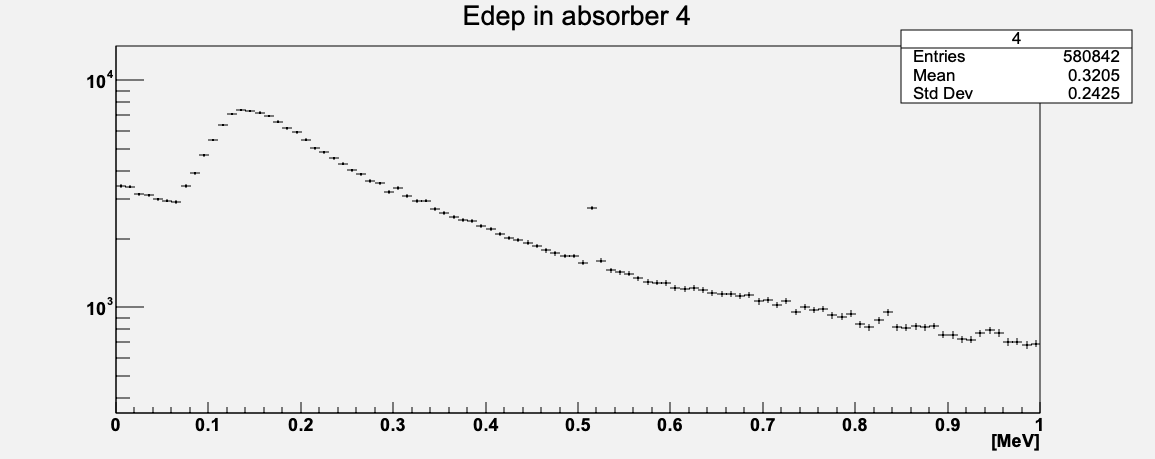
Im afraid I dont fully appreciate understand your answer. So in addition here are the results of a TestEm3 simulation on the following stack.
1-Vacuum(Galactic)
2-Copper
3-Vacuum(Galactic)
4-Caesium Iodide
5-Vacuum(Galactic)
Using E1E2MeV.mac. The geometry is obviously not the same as B1. The spectral plots are only to 1MeV on the assumption that the energy deposited and processes will trickle down to low energies. Those of the the vacumm regions show no energy deüosited as I would expect. So Im afraid i dont understand the results of B1.
best regards, david batchelor
p.s. I will have to look at the code and learn more c++
Just wondering if we are missing the most obvious of explanations. The dose is energy deposited per unit mass. For Galactic, the mass is very small, so even if very little energy is deposited, the dose can be commensurate with normal materials. As always, the dose depends on the composition - in fact, only on composition and type and energy of radiation. It should be otherwise independent of density. See code in B1’s RunAction::EndOfRunAction:
Hallo John,
You are of right. my stupid mistake. I shall have to look for a differnt reason for the high dose or at least further check this. Thankyou John.
Hallo John, Michel,
I have replaced volume 2 material of B1 with Ar and also liquid Ar and see the following difference with dose with exampleB1.in and 1E6 particles (6MeV gammas and 210MeV protons)
Gas Ar 33.345 nanoGy and 2.715 microGy
Liguid Ar 42.157 nanoGy.and 3.168 microGy
This is perhaps not so surprising as the density is very different and therefore the scattering also different.
In addition I changed the physical model so that all volumes except the second (Copper) was galactic. The source was changed to electrons of 50MeV and 200MeV and a point source- the dose will not be homogene and found there was no mentionable difference between the Physics Lists- 1E6 e- 50Mev 827.59 nanoGy and 200MeV 2.690 microGy.
I am still no clearer to the discrepancy but the results are more consistent. Thanks for the feedback.