Fast neutrons from reaction of deutrons (energy up to 2 MeV) with 7Li/6Li

Please fill out the following information to help in answering your question, and also see tips for posting code snippets. If you don’t provide this information it will take more time to help with your problem!

Geant4 Version: 11.4.1
Operating System: ubuntu 24.04
Compiler/Version: gcc 13.3.0
CMake Version: 3.28.3


I have question about simulation of the yield of fast neutrons. So, task is
next - deuterons with energy up to 1.5 MeV hit to natural lithium target (7Li/
6Li - 92.5/7.5). Main nuclear reaction are:

  1. 7Li(d,n)8Be, then 8Be->alpha+alpha
  2. 7Li(d,n)alpha+alpha
  3. 7Li(d,alpha)5He, then 5He->n+alpha
  4. 6Li(d,n)7Be
  5. 6Li(d,3He)5He, then 5He->n+alpha

I used G4VModularPhysicsList* phys_list = new QGSP_BIC_AllHP(0).
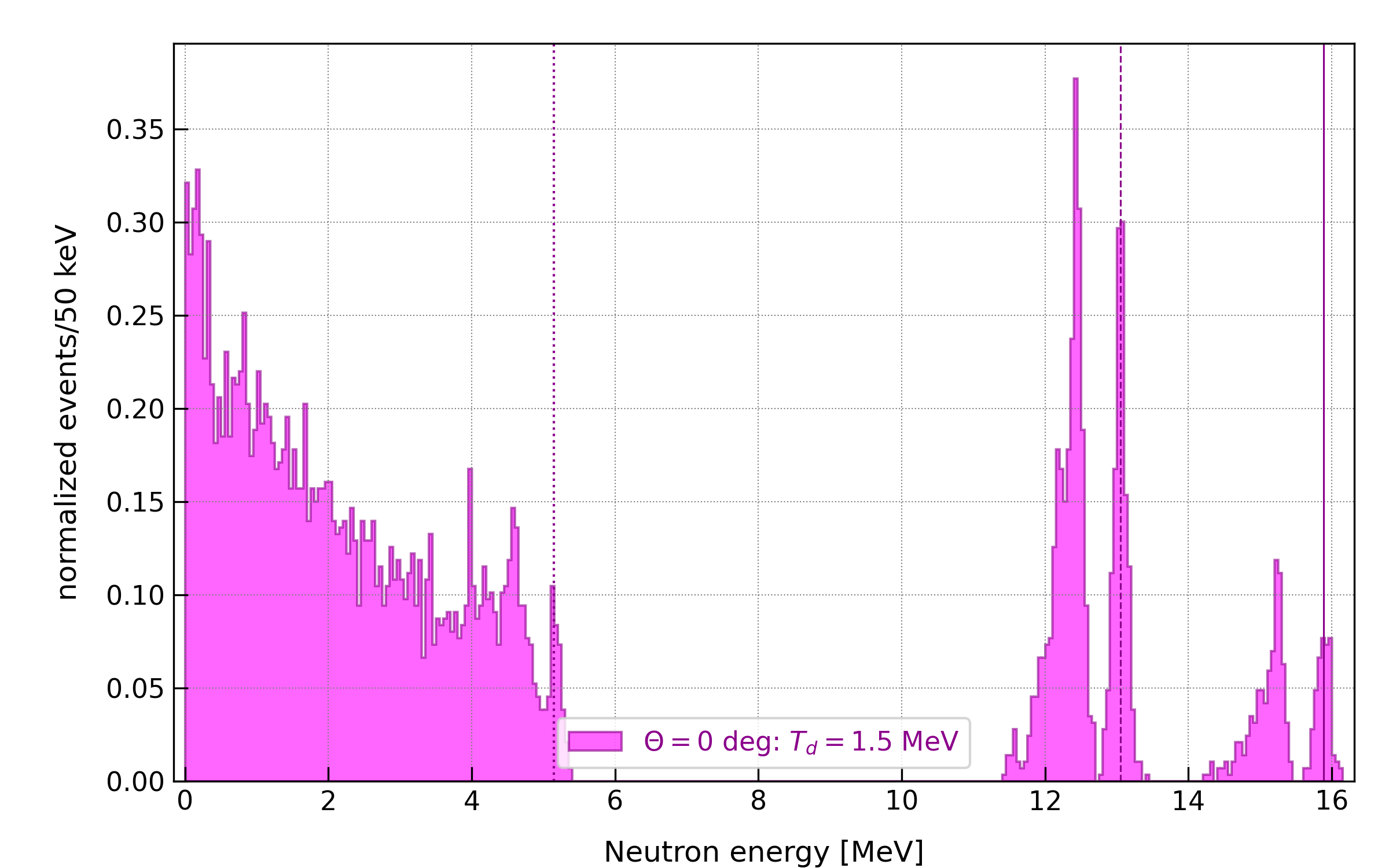
I see 3 resonances for 8Be - gs, 3.03 MeV and 11.25 MeV conditions from
7Li(d,n)8Be reactions (see the attachment, 3 lines correspond 3 resonances)
and few background up to 5 MeV. Background it seems coming from 3) and 5)
reactions.
Additionally info is next:
* creator process: dInelastic, neutronInelastic
* number of processes: 17
7Li(d,n): 2685413 (94.765%)
6Li(d,n): 77534 ( 2.736%)
7Li(d,n)n: 22789 ( 0.804%)
7Li(d,n)n_n: 17402 ( 0.614%)
7Li(d,n)n_n_n: 12690 ( 0.448%)
7Li(d,n)n_n_n_n: 8206 ( 0.290%)
7Li(d,n)n_n_n_n_n: 4483 ( 0.158%)
6Li(d,n)n: 1176 ( 0.041%)
6Li(d,n)n_n: 1022 ( 0.036%)
6Li(d,n)n_n_n: 790 ( 0.028%)
7Li(d,n)n_n_n_n_n_n: 784 ( 0.028%)
6Li(d,n)n_n_n_n: 650 ( 0.023%)
6Li(d,n)n_n_n_n_n: 438 ( 0.015%)
6Li(d,n)n_n_n_n_n_n: 256 ( 0.009%)
6Li(d,n)n_n_n_n_n_n_n: 131 ( 0.005%)
6Li(d,n)n_n_n_n_n_n_n_n: 5 ( 0.000%)
7Li(n,n)7Li_g: 2 ( 0.000%)

It is very strange - any alpha particles did not observed.
From 2) reaction I expected wide continuum, from 0 to 15 MeV, but I did not
see.

What is nature of secondary peaks for each resonance in 7Li(d,n)8Be reaction
(I mean 8Be in gs and 3.03 MeV) ? Why peak for 8Be in 3.03 is very narrow - it
has own width about 1.5 MeV. The same for 8Be in 11.35 condition (width is 3.5
MeV).

So, my question - what is right way to simulation yield of fast neutrons in
Geant4 (physics list, cuts and so on) ?

Best regards,
Viktor
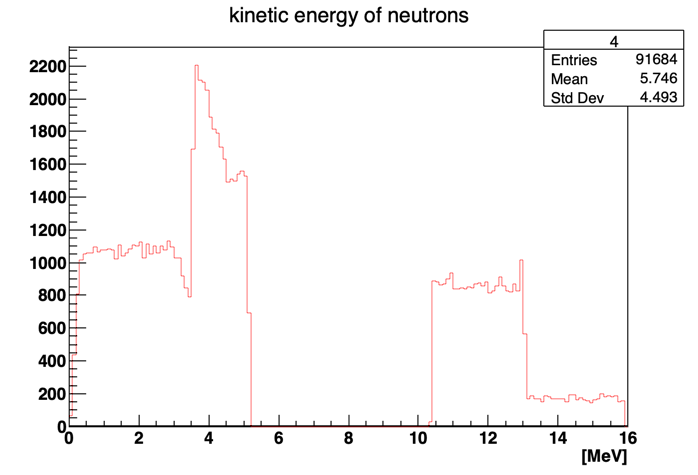
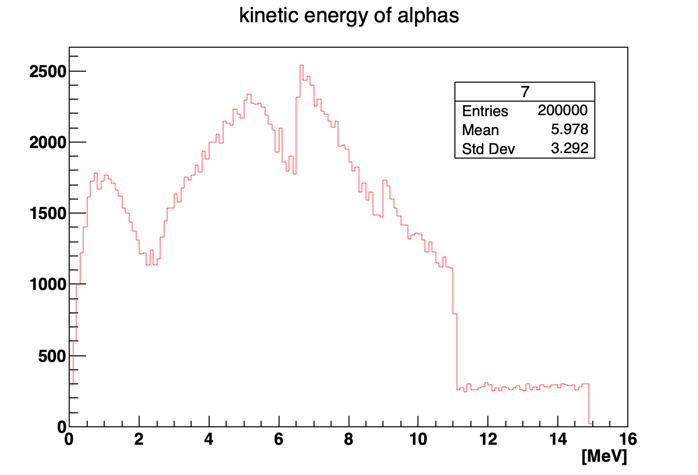
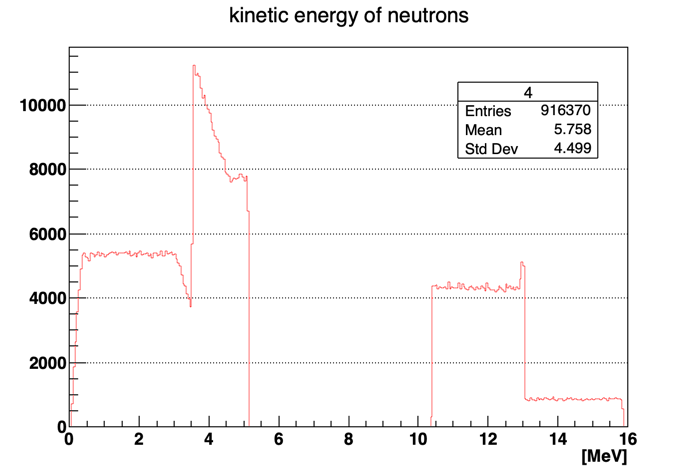
Here, a run of example Hadr03 and the plots of neutrons and alphas.

victor.mac.txt (380 Bytes)

victor.out.txt (3.3 KB)

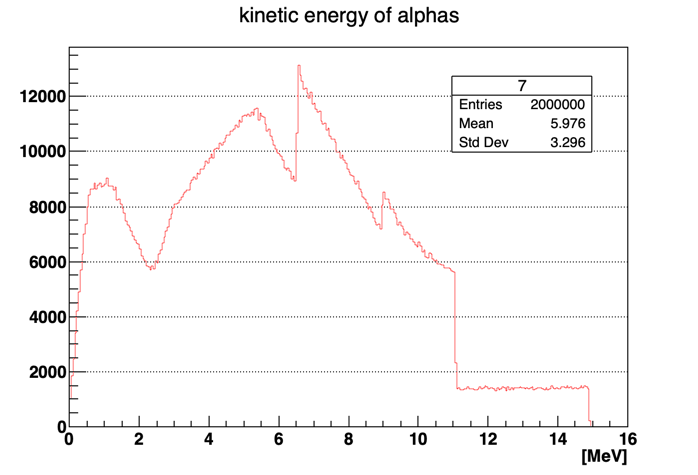
for completion, a run with more events and a refined binning.

victor.mac.txt (382 Bytes)

victor.out.txt (3.4 KB)

Dear Maire1,

thank a lot for you help.

So, I made calculation with physics list as in Hadr03.

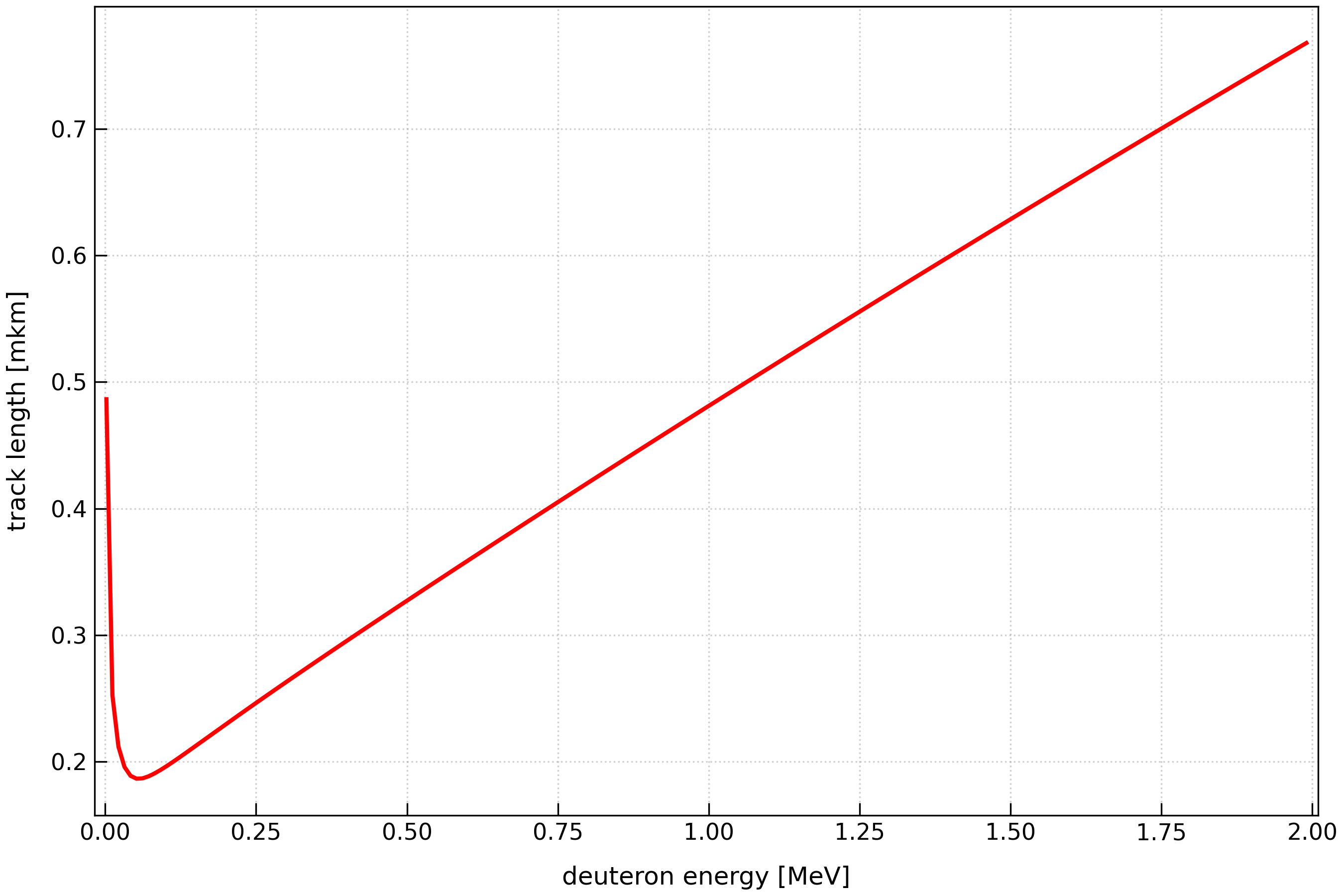
It is length of deuteron track [cm] vs energy - results from geant4 and it is very strange results

root_length_vs_energy.pdf (21.5 KB)

Here results from https://lief.if.ufrgs.br/pub/CasP/ - you can see a smooth, falling curve with a rapid rise in the low-energy region following the Bragg peak.

Hadr03 compute and print the nuclear interaction length, also called mean free path.

Do we speak of the same thing ?

I`m not think so.

I mean stopping power S=-dE/dx [MeV/cm].

For that I made:

in RunAction::BeginOfRunAction(const G4Run*) {

…

auto an_man = G4AnalysisManager::Instance();

an_man->CreateH1(“L_Ed”, “Track length of deuterons vs energy”, 250, 0.0, 2.5, “MeV”);

…

}

and in SteppingAction::UserSteppingAction(const G4Step* step) {

…

G4Track* p_track = step->GetTrack();
G4ParticleDefinition* p = p_track->GetDefinition();
std::string p_name = p->GetParticleName();
if (p_name!=“deuteron”) return;
if (p_track->GetTrackID()!=1) return;
// - volume check
auto vol = p_track->GetVolume();
if (vol && vol->GetName()!=“layer_phys”) return;

…

G4double energy = step->GetPreStepPoint()->GetKineticEnergy();
G4double length = step->GetStepLength();
auto an_man = G4AnalysisManager::Instance();
an_man->FillH1(0, energy/MeV, length/mm);

…

}

If you are trying to compute stopping power it is better to just directly get the change in kinetic energy to make like to like comparison, i.e.

dE → change in kinetic energy

Like:

deltaKE = -(step->GetPostStepPoint()->GetKineticEnergy() - step->GetPreStepPoint()->GetKineticEnergy());

How to interpret a 1D histogram of kinetic energy with StepLength as a weight ?

Computation of stopping power is illustrated in example TestEm5

victorb.mac.txt (402 Bytes)

victorb.out.txt (2.0 KB)