_Geant4 Version: 10.7
_Operating System: Ubuntu WSL
Hi everyone,
As I proceed with the design of a PCB antenna for space applications, I decided—before analyzing the effects of space radiation on a multilayer structure—to first validate my simulation code by comparing its results with reference data from the literature.
In this particular case, I studied the depth-dose distribution for protons in an aluminum monolayer and obtained the following results:
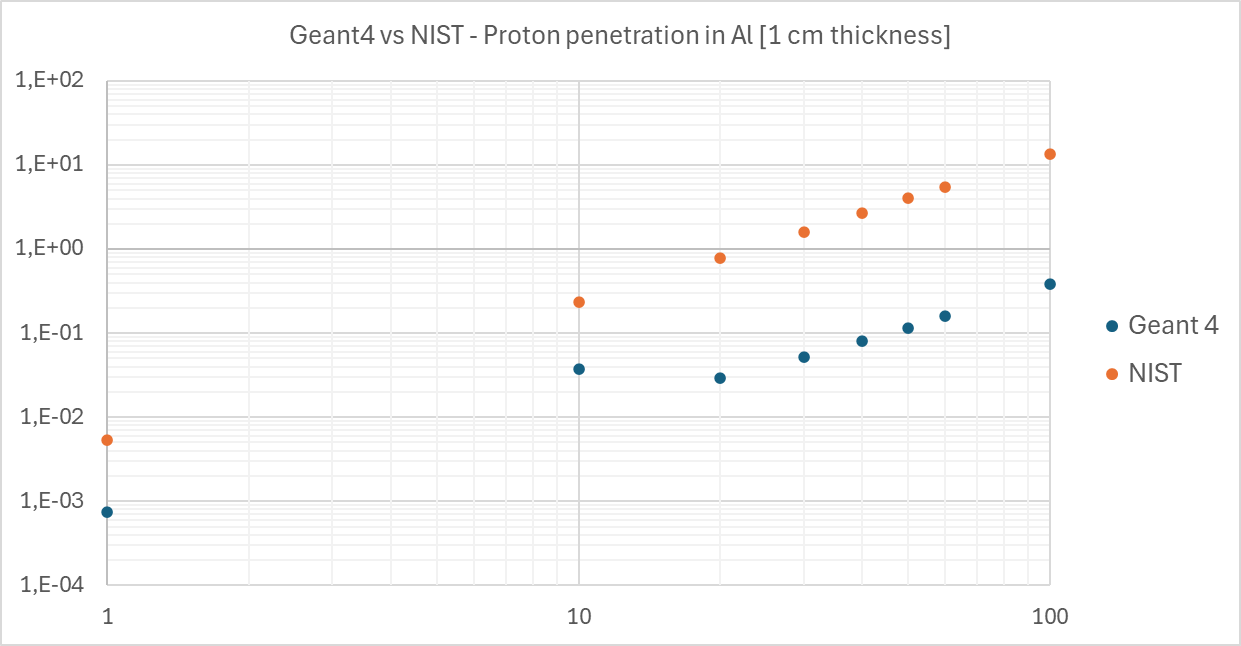
we simulated single proton particles with energies ranging from 1 to 100 MeV.
However, I’m observing a discrepancy of about one order of magnitude compared to the expected values, and I haven’t yet identified the source of the error.
Here are some additional details:
a. PrimaryGenerationAction
PrimaryGeneratorAction::PrimaryGeneratorAction()
{
fParticleGun = new G4ParticleGun(1); // 1 particle per event
G4ParticleTable* particleTable = G4ParticleTable::GetParticleTable();
G4ParticleDefinition* proton = particleTable->FindParticle(“proton”);
fParticleGun->SetParticleDefinition(proton);
} […]
b. PhysicsList
#include “PhysicsList.hh”
#include “G4DecayPhysics.hh”
#include “G4EmStandardPhysics_option4.hh” // EM Opt4 for higher accurancy
//#include “G4EmLivermorePhysics.hh”
#include “G4VUserPhysicsList.hh”
#include “G4HadronPhysicsQGSP_BIC.hh” // Hadron Physics per space < 1.5 GeV
#include “G4IonPhysics.hh”
//#include “G4GenericIon”
#include “G4ParticleTable.hh”
#include “G4ProcessManager.hh”
#include “G4StoppingPhysics.hh”
#include “G4SystemOfUnits.hh”
#include “G4Transportation.hh”
#include “G4UnitsTable.hh”
// Particelle coinvolte
#include “G4Alpha.hh”
#include “G4Deuteron.hh”
#include “G4Electron.hh”
#include “G4Gamma.hh”
#include “G4GenericIon.hh”
#include “G4Neutron.hh”
#include “G4PionMinus.hh”
#include “G4PionPlus.hh”
#include “G4PionZero.hh”
#include “G4Positron.hh”
#include “G4Proton.hh”
#include “G4Triton.hh”
PhysicsList::PhysicsList()
{
// === Fisica elettromagnetica dettagliata (Opt4) ===
RegisterPhysics(new G4EmStandardPhysics_option4());
//RegisterPhysics(new G4EmLivermorePhysics());
// === Fisica adronica (Binary Cascade sotto 1.5 GeV) ===
RegisterPhysics(new G4HadronPhysicsQGSP_BIC());
// Decadimenti (muoni, pioni, nuclei ecc.)
RegisterPhysics(new G4DecayPhysics());
// Stopping physics (es. muoni o anti-protoni a riposo)
RegisterPhysics(new G4StoppingPhysics());
// Fisica degli ioni leggeri e pesanti
RegisterPhysics(new G4IonPhysics());
}
PhysicsList::~PhysicsList() {}
void PhysicsList::ConstructParticle()
{
// Definizione manuale delle particelle pių importanti
G4Proton::ProtonDefinition();
G4Neutron::NeutronDefinition();
G4Gamma::GammaDefinition();
G4Electron::ElectronDefinition();
G4Positron::PositronDefinition();
G4PionPlus::PionPlusDefinition();
G4PionMinus::PionMinusDefinition();
G4PionZero::PionZeroDefinition();
G4Deuteron::DeuteronDefinition();
G4Triton::TritonDefinition();
G4Alpha::AlphaDefinition();
G4GenericIon::GenericIonDefinition();
// Necessario per il trasporto nello spazio
AddTransportation();
}
void PhysicsList::ConstructProcess()
{
// Recupera il particle table
G4ParticleTable* particleTable = G4ParticleTable::GetParticleTable();
for (int i = 0; i < particleTable->entries(); ++i) {
G4ParticleDefinition* particle = particleTable->GetParticle(i);
G4ProcessManager* pManager = particle->GetProcessManager();
if (!pManager) continue;

// Aggiungi processo di trasporto
pManager->AddProcess(new G4Transportation(), -1, -1, 1);
}
}
void PhysicsList::SetCuts()
{
G4cout << “[DEBUG] SetCuts(): inizio impostazione cut values…” << G4endl;
if (G4ParticleTable::GetParticleTable()->FindParticle(“proton”)) SetCutValue(0.001 * mm, “proton”);
if (G4ParticleTable::GetParticleTable()->FindParticle(“e-”)) SetCutValue(0.001 * mm, “e-”);
if (G4ParticleTable::GetParticleTable()->FindParticle(“e+”)) SetCutValue(0.001 * mm, “e+”);
if (G4ParticleTable::GetParticleTable()->FindParticle(“gamma”)) SetCutValue(0.001 * mm, “gamma”);
DumpCutValuesTable();
G4cout << “[DEBUG] SetCuts(): completato” << G4endl;
}
c. Main.cc
[…]
// ===== [ User Initialization Classes ] =====
runManager->SetUserInitialization(new DetectorConstruction()); // Geometria
runManager->SetUserInitialization(new QBBC()); // Physics list
runManager->SetUserInitialization(new ActionInitialization()); //
[…]