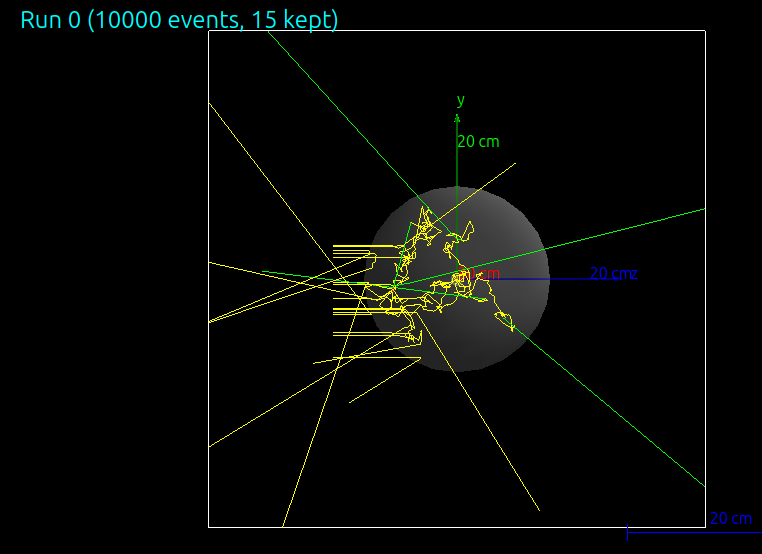
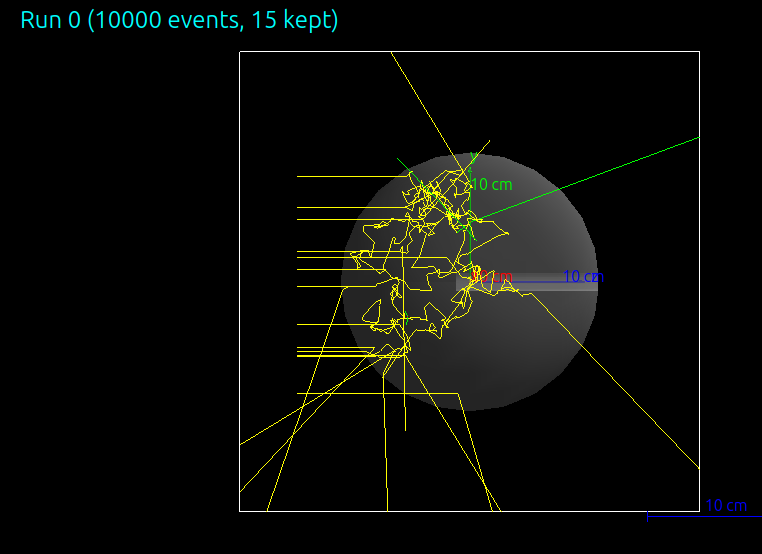
I have defined a spherical volume with an inner radius of 0 cm and an outer radius of 11.25 cm. From this sphere, I subtract a cylindrical region with a radius of 0.8 cm and a height of 12.5 cm, such that one face of the cylinder lies on the outer surface of the sphere.
Inside this cylindrical cut region, I define a smaller cylindrical detector with a radius of 5 mm and a height of 1 mm. The material assigned to the cylindrical cut portion is air. The mother volume of the sphere is defined as the world volume.
I am unsure about the correct choice of mother volumes for the cylindrical cut portion and for the detector. Should the cylindrical cut region be placed directly inside the world volume or inside the sphere, and where should the detector be placed in this hierarchy?
I would appreciate any clarification regarding the proper geometry hierarchy for this setup in Geant4.
This is my current geometry setup: I have defined a world box filled with air. Inside the world volume, I placed an HDPE sphere and a detector. In this configuration, there is no cylindrical cutout in the sphere.
When I set the mother volume of the detector to logicSphere, I do not observe any alpha counts when neutrons are incident on the sphere. However, when I set the mother volume of the detector to the World volume, I start observing some alpha counts.
I am unsure why changing the mother volume affects the alpha counts in this way. Could you please clarify what might be causing this behavior?
I I created a cylindrical cutout in the sphere. I defined the cylindrical portion as a logical volume filled with air and placed the detector at the centerThe mother volumes of both the cylindrical cutout and the detector are set to the World volume. However, even in this configuration, I do not observe any alpha counts.
I am unsure what might be causing this issue and whether the geometry hierarchy or placement is incorrect. I would appreciate any guidance on how to correctly define the mother volumes and geometry for this setup in Geant4.
When I create a cylindrical cutout from the sphere and place the detector inside this region, I observe alpha counts if the detector is placed appropriately. However, when I explicitly define the cylindrical cutout volume (logicHole) filled with air and set its mother volume to logicWorld, I no longer observe any counts.
I am unsure why defining the cylindrical cutout as a separate logical volume placed in the world volume causes the alpha counts to disappear.Sir
Could you please suggest the correct way to define the cylindrical cutout and its mother volume
I implemented the geometry as you suggested, and I was able to observe the alpha counts. However, I would also like to explicitly define the cylindrical cutout (hole) region and fill it with air.
I am unsure what the correct mother volume for this cylindrical hole should be. If I set the mother volume of the cylindrical hole to the World volume, the alpha counts disappear.
Could you please advise whether the cylindrical hole should have the World as its mother volume, or if it should instead be placed inside the sphere? Thank you so much for your guidance
If you place the cylindrical hole into the sphere as a daughter volume, then some part of the cylinder will extend beyond the sphere. Geant4 will warn you about an overlap. This is why I suggested to apply G4SubtractionSolid.
If you wish to explicitly define the cylindrical cutout region filled with air, then I would suggest to replace the sphere with a box (or cylinder) and place the cylindrical hole inside.
Alternatively you can subtract the hole from the sphere and then place the cylinder with air into the hole. In this case both the sphere with hole and the cylinder should be placed in the World.
I just realised that there is a way to construct a sphere with a cylindrical hole defined as a daughter volume without facing the overlap problem. Use G4Ellipsoid instead of G4Orb. An ellipsoid can be constructed with a cut on one side, allowing a cylinder to be inserted into it without going beyond the boundary.