Geant4 Version: 11.3.2
Operating System: Debian GNU/Linux 13 (trixie)
Compiler/Version: gcc 14.2.2
CMake Version: 3.31.6
Dear Geant4 experts,
I am simulating the ionization of a gas detector by fission fragments from neutron‑induced fission of U‑235. My goal is to obtain the charge spectrum (number of ion‑electron pairs created) in a segmented gas volume. However, I consistently observe a shift towards a higher number of electrons compared to reference expectations. I have tried many standard adjustments, but the overestimation persists.
Geometry:
A thin layer of U₃O₈ (fission source) enclosed in steel tubes. Surrounding it, 20 concentric gas‑filled cylindrical layers (detectors) with Ar + 4% N₂ at 5 atm (density ~8.04 mg/cm³). Neutrons are generated from a primary source (thermal‑like spectrum) and fission occurs in the U₃O₈.
Scoring:
I score the energy deposited by fission fragments (and their secondaries) inside each gas layer. The number of electrons is then derived as N_e = E_dep / W, with W ≈ 26.4 eV for Ar/N₂.
The reconstructed electron spectrum is systematically shifted towards higher electron multiplicities than expected.
Physics lists:
FTFP_BERT_HP (with and without replacing EM physics with G4EmStandardPhysics_option4 ). I also added G4IonPhysics and G4IonPhysicsPHP.
Energy deposit treatment:
I used GetTotalEnergyDeposit() directly. And I also subtracted GetNonIonizingEnergyDeposit() – this did not improve the spectrum.
Below are the spectra that I obtain for two configurations of ionization chambers and the spectra given in publications.
Fission chambers CFUR and CF4 (my and reference spectrum and characteristics of this chambers):
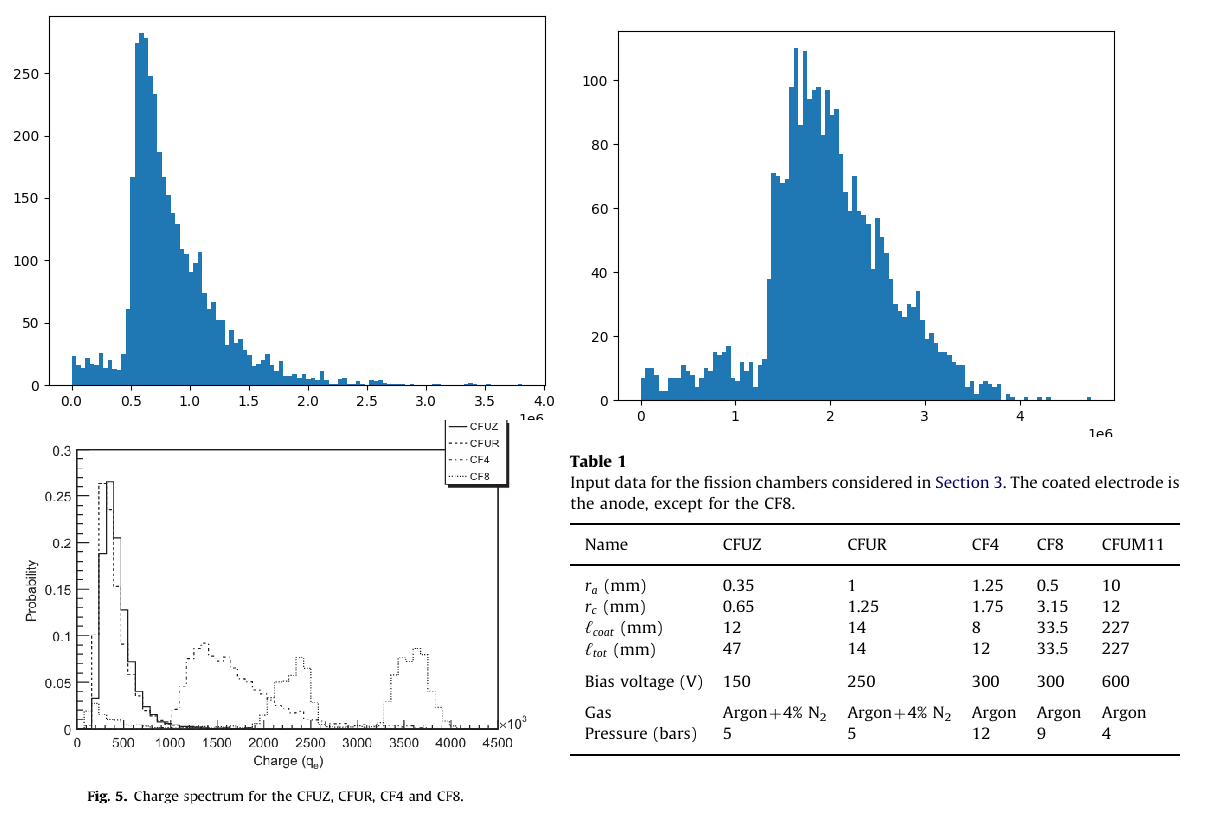
Additionally, in my previous simulation of the CF8 fission chamber, the charge spectrum matched the reference from the article, with only a minor shift - far less pronounced than the one observed in the present configuration.
I would be grateful to hear your thoughts on these issues.