Please fill out the following information to help in answering your question, and also see tips for posting code snippets. If you don’t provide this information it will take more time to help with your problem!
While trying to simulate the neutron yield from photonuclear reactons I found out that the number of observed fast neutrons is somewhat less than expected.
To pin up the origin of the problem I took the example ‘Hadr03’ with tungsten as a chosen material and used it to produce neutrons spectra from incident 120 MeV gammas. The example uses QGSP_BIC_HP physics list by default and it also has an option to choose GammaNuclearPhysics from LEND database or leave as it is. I run this test with the latest G4 version 11.4.1 and with the one I currently stick to, version 11.0.4:
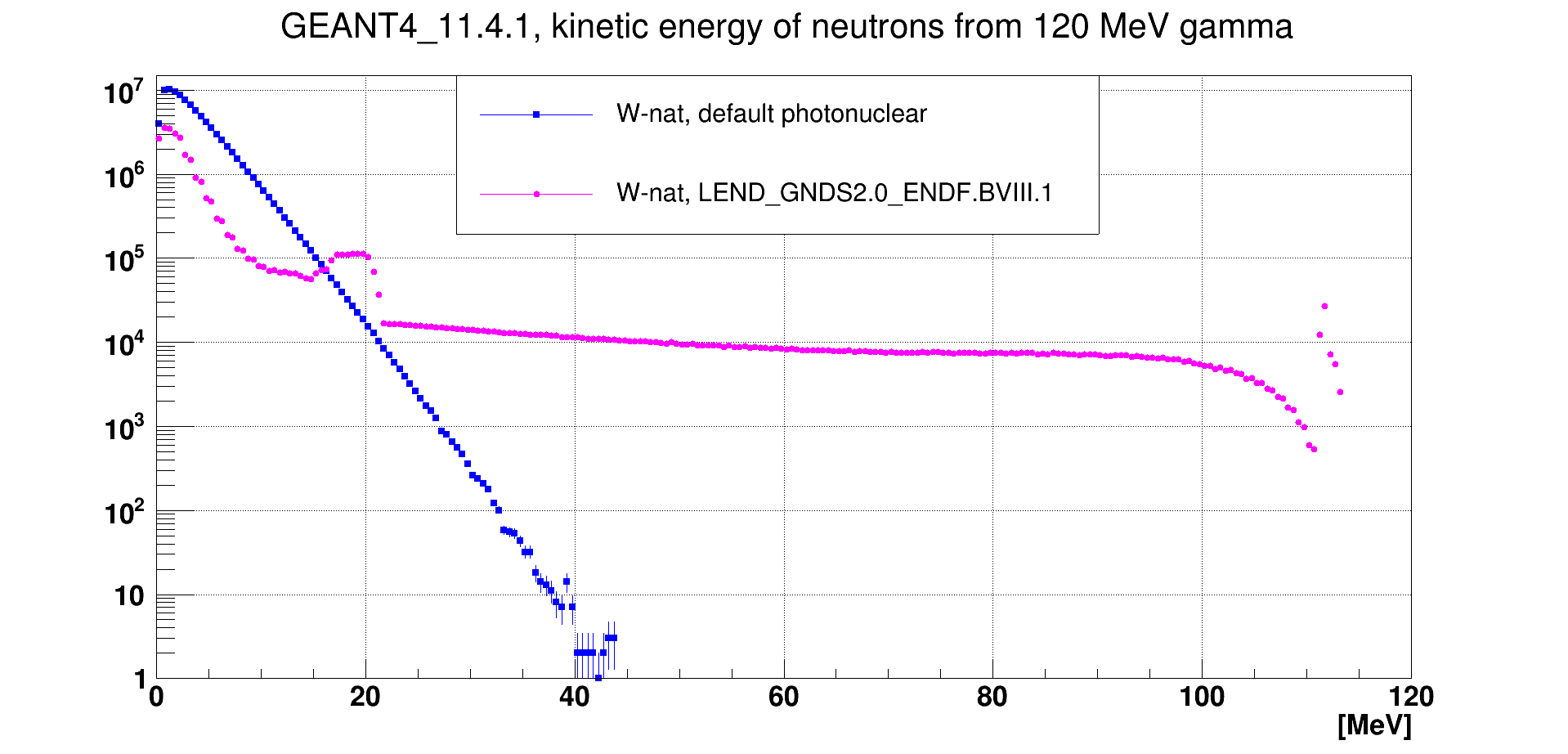
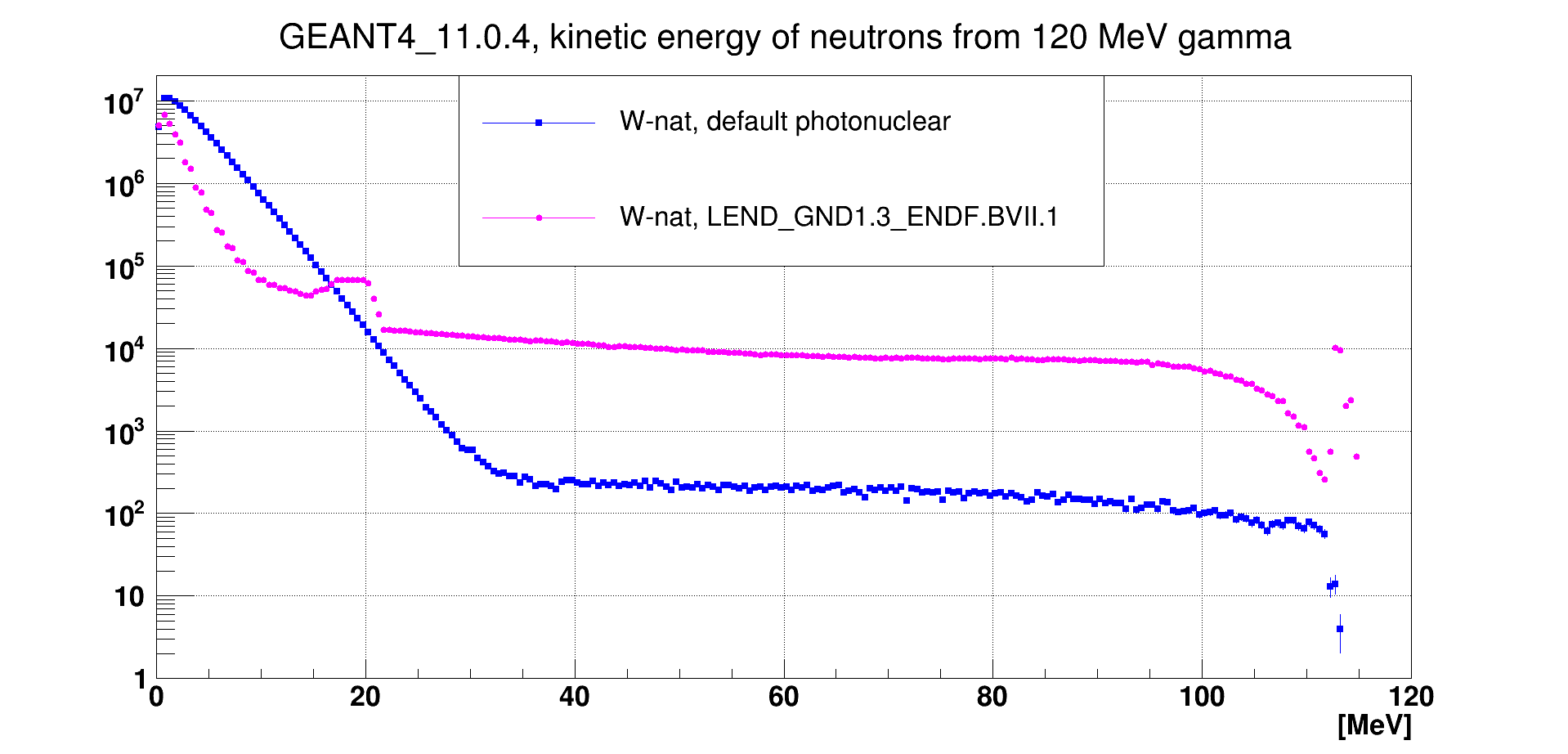
So the obvious observation is that fast neutrons which are expected from pre-equilibrium photonuclear reactions are not produced in the 11.4.1 and are produced about two orders of magnitude less than the LEND exp.data driven model predicts in the 11.0.4. Leaving alone the kink around 20 MeV in the LEND spectrum (transition between the models?), the amount of fast neutrons compared to thermal neutrons produced by it looks more reasonable. Also there is a kind of a kink at the end of the LEND spectrum which might be attributed to the simulation of a direct photon-nucleon reaction and it is not observed in the default spectrum.
The ‘mac’-file used to produce the spectra from ‘Hadr03’ is:
еhe Geant4 LEND documentation says that for gamma-induced reactions LEND is mainly for low energy, especially below 20 MeV. So it is not the right reference model for a 120 MeV gamma.
If you want to use LEND you will need to create your own modular physics list.
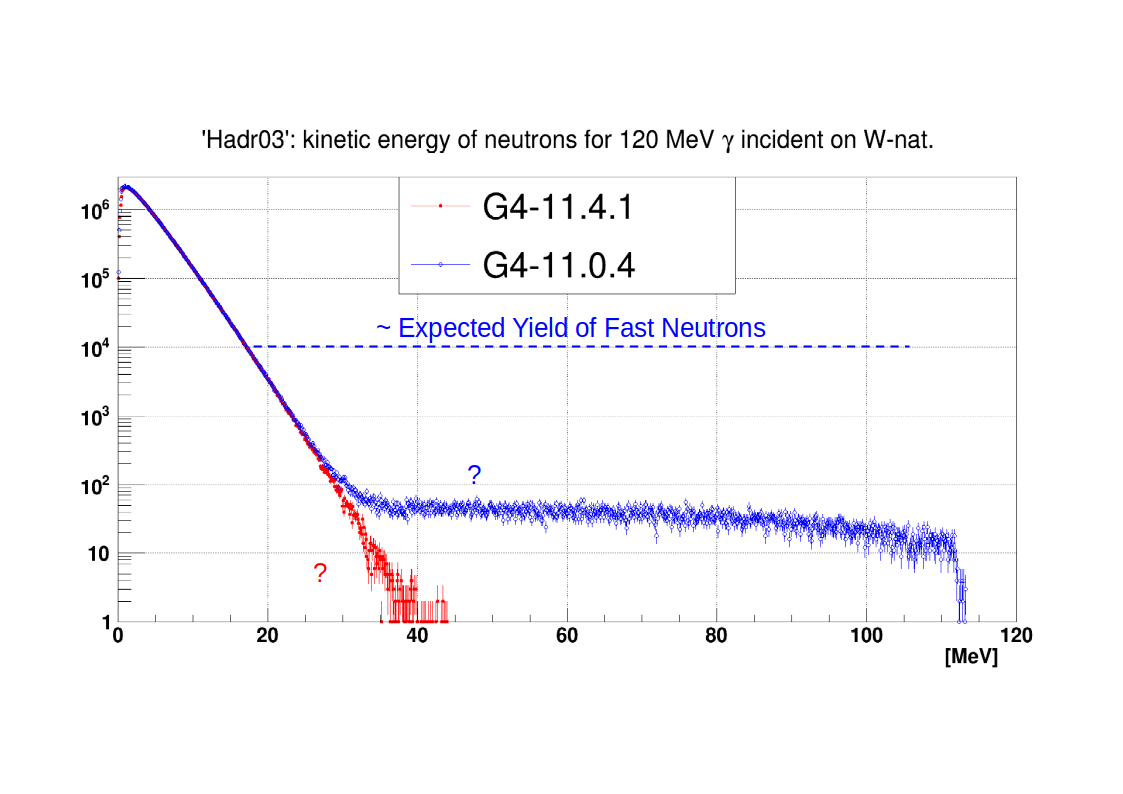
I could not reproduce a “good” 11.0.4 LEND result. With 11.0.4 and the old LEND_GND1.3_ENDF.BVII.1 data, I also see a broad high-energy tail similar to 11.4.1…
If you want to test LEND in the standard Geant4 way, you should use ShieldingLEND or make your own modular physics list. Hadr03 does not provide a standard LEND configuration.
Let`s split the problem into two parts to keep it clear:
Comparing the older 11.0.4 release with the latest one 11.4.1, the latest does not reproduce pre-equilibrium (fast) neutron component in the photoneutron spectrum with the QGSP_BIC_HP physics list which is the default in the ‘Hadr03‘ example. That is the blue curve on the top plot does not have a high-energy ‘shoulder‘ which exists on the same blue curve on the bottom plot in the starting message.
The predicted amount of pre-equilibrium (fast) neutrons in the older release 11.0.4 looks suspiciously small as far as I can only guess. Here I compare the total number of neutrons in the left and right parts of the blue curve on the bottom plot, which again refers to QGSP_BIC_HP physics list. From the early experimental works the value of the fast neutron fraction for heavy elements should be about ~0.1 for incident gamma energies 15-30 MeV if I remember right.
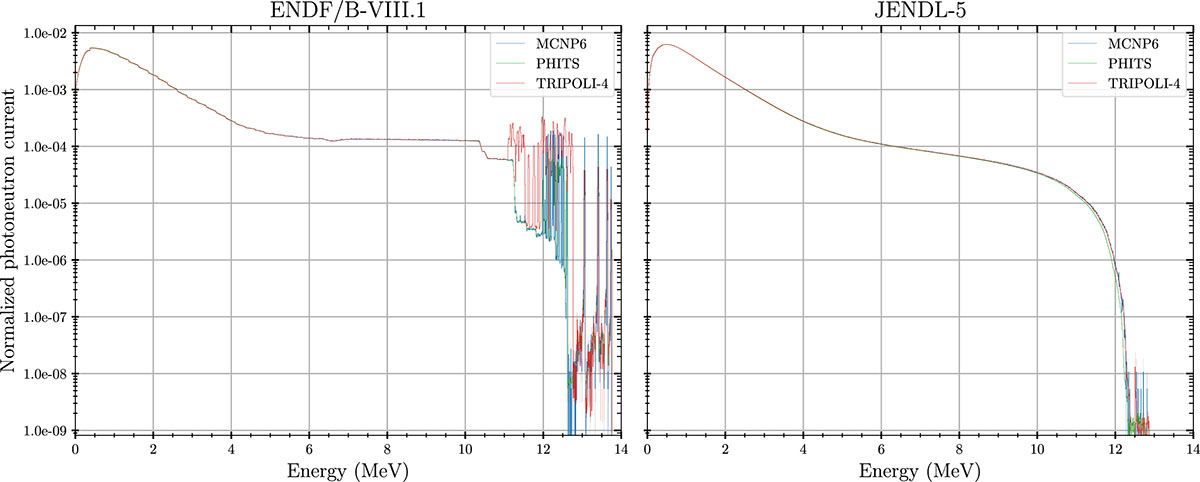
For the cross check I could suggest the Monte-Carlo comparison plots for photoneutron energy distributions from natural tungsten obtained from this paper:
The difference in the left and right plot here occurs from using the photonuclear cross section from different databases. What is relevant to the topic is the ratio between the thermal low-energy peak and the pre-equilibrium shoulder. It is clearly not six orders of magnitude as in the G4 simulation using default ‘Hadr03’ example but rather resembles the outcome of the G4 simulation using LEND - the magenta dots on both top and bottom plots. So the only purpose of using LEND from my side was just to have something to compare, let`s forget about it completely.
This might be the reason for discrepancy between latest version 11.4.1 and the old one 11.0.4,
however comparing with MCNP6 there are still fewer fast neutrons in 11.0.4 and none in 11.4.1:
Pre-compound/De-excitation Physics Parameters for 11.0.4:
=======================================================================
Type of pre-compound inverse x-section              3
Pre-compound model active                           1
Pre-compound excitation low energy (MeV)            0.1
Pre-compound excitation high energy (MeV)           30
Type of de-excitation inverse x-section             3
Type of de-excitation factory                       Evaporation+GEM
Number of de-excitation channels                    68
Min excitation energy (keV)                         0.01
Min energy per nucleon for multifragmentation (MeV) 2e+05
Limit excitation energy for Fermi BreakUp (MeV)     20
Level density (1/MeV)                               0.075
Use simple level density model                      1
Use discrete excitation energy of the residual      0
Time limit for long lived isomeres (ns)             1442.7
Isomer production flag                              1
Internal e- conversion flag                         1
Store e- internal conversion data                   1
Correlated gamma emission flag                      0
Max 2J for sampling of angular correlations         10
=======================================================================
Geant4 Native Pre-compound Model Parameters / Nuclear De-excitation Module Parameters for 11.4.1
=======================================================================
Type of pre-compound model                          0
Type of pre-compound inverse x-section              1
Pre-compound model active                           1
Pre-compound excitation low energy                  0.1 MeV
Pre-compound excitation high energy                 15 MeV
Angular generator for pre-compound model            1
Use NeverGoBack option for pre-compound model       0
Use SoftCutOff option for pre-compound model        0
Use CEM transitions for pre-compound model          1
Use GNASH transitions for pre-compound model        0
Use HETC submodel for pre-compound model            0
=======================================================================
Type of de-excitation inverse x-section             3
Type of de-excitation factory                       Evaporation+GEM
Number of de-excitation channels                    68
Type of Fermi BreakUp model                         ModelVI
Min excitation energy                               0.01 keV
Min energy per nucleon for multifragmentation       2e+05 MeV
Level density (1/MeV)                               0.075
Use simple level density model                      1
Use discrete excitation energy of the residual      0
Time limit for long lived isomeres                  1 ns
Isomer production flag                              1
Internal e- conversion flag                         1
Store e- internal conversion data                   1
Correlated gamma emission flag                      0
Max 2J for sampling of angular correlations         10
=======================================================================