Based on the simulation results shown above, the production yield of 104mRh appears lower than expected. Does this discrepancy conflict with theoretical predictions? Could you please explain how to generate 104mRh using G4NEUTRONXS as indicated in the diagram? Would this require manually registering a custom physics process?
I am unable to answer these questions. I hope that better experts will help you !
Thank you for your reply again.
In my previous mails, I have forgotten to mention something evident : level 128.294 keV is fed by deexcitation of level 344.594 keV.
With rdecay01, we can see that 100000 [344.594] give 98333 [128.994]
(I think you will get same result with geant4 11.3.2)
tang.mac.txt (161 Bytes)
tang.out.txt (5.8 KB)
Thank you for the reminder. Do you know what results in [344.594]?
According Geant4 11.4.beta : n (25 meV) + Rh103 → Rh104[344.594] 81.68%
Hello, could you please provide the official release notes documenting the changes between version 11.3.2 and version 11.4.0?
Release notes are under the beta download page here: Download Geant4-11.4.0.beta - Geant4
Hello, may I ask where I can plot a relationship diagram showing the number of decaying nuclei over time like the one you provided? For example, I now want to see the relationship diagram of the number of Rh nuclei decaying into Pd over time.
I assume you know how the tracking of particles works in Geant4, and how the examples are structured.
In example rdecay01, histograms are defined in HistoManager class. They are activated individually with the command /analysis/h1/set
You can modify this list, eg. add an histogram.
Histogram 8 is filled in TrackingAction.cc, around lines 188-189 : FillH1(8,time)
tang.mac.txt (278 Bytes)
Hello, thank you for your reply. I have a question that has puzzled me for a long time that I’d like to ask you. Regarding the reaction where ¹⁰³Rh reacts with neutrons to produce both ¹⁰⁴Rh and ¹⁰⁴ᵐRh, can I calculate these two reactions separately? That is, one reaction producing essentially only ¹⁰⁴Rh, and another reaction producing only ¹⁰⁴ᵐRh. Can I then add the results of these two calculations together to represent the single reaction that produces both ground state ¹⁰⁴Rh and metastable ¹⁰⁴ᵐRh? If so, why? If not, why not?
The process is Neutron Capture (by Rh103). Its cross section for thermal neutrons is ~143 barn.
Production of Rh104, Rh104m, Rh[344 keV] are channels of this process
(respectively: 15%, 3%, 82%)
In Geant4 it is not foreseen to ‘force’ a given channel.
Thank you for your reply.I want to know that how to attain a certain of channel that production of Rh104, Rh104m, are channels of this process
(respectively: 93%, 7%)
Here, a macro for example radioactivedecay/Activation.
The plot is the evolution of Rh104m and Rh104 populations after an irradiation of Rh103 by 100000 thermal neutrons.
tang.mac.txt (677 Bytes)
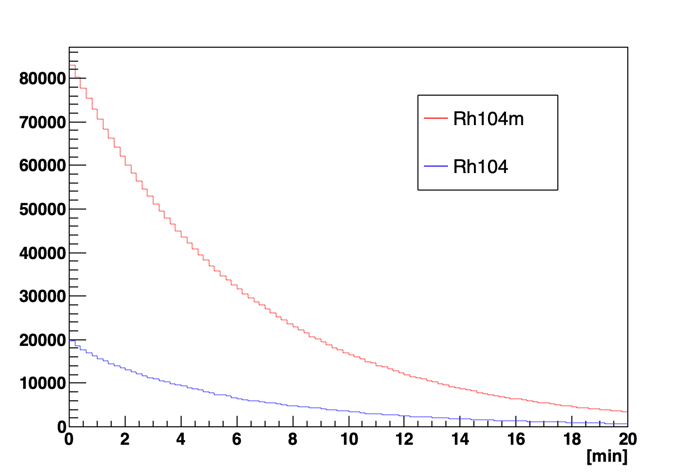
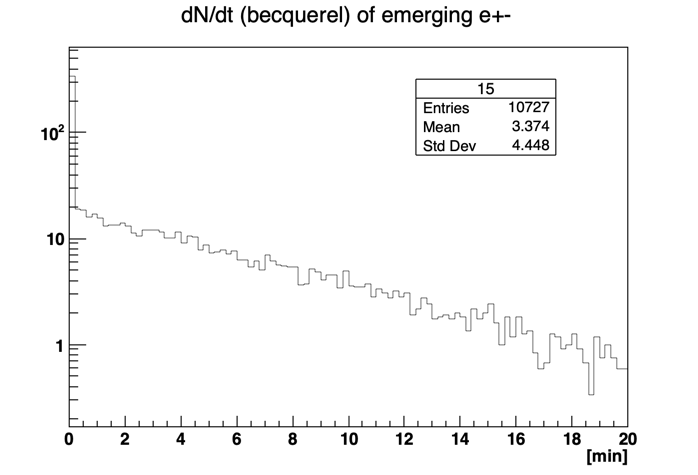
Thank you for you’re reply.It looks like that the quantity of 104mRh is more than 104Rh produced by 103Rh(n,γ).So is this default in Geant4? It’s strange. Do corrections need to be made by myself in this part?
If you believe that neutron capture cross-sections may be not correct, please send a mail to Vladimir.Ivantchenko@cern.ch and/or open a bugzilla item :
OK,thank you for you’re reply again.
To be compatible with https://www.nndc.bnl.gov/ensnds/104/Rh/ng_E_thermal.pdf
G4 neutron capture process must include, at least, level Rh104[269.274 keV]
(by the way, this state is already in PhotonEvaporation data set )
Respected G4 Experts, how can we do this ?
Rh103.out.txt (1.4 KB)
Hello, I am using the QBBC physics process in version 10.7.0 for calculations, but all the products obtained from this reaction process are Rh[128.968 keV]. Moreover, when I used Hadron3 to test the reaction cross-section of this physics process, it actually reached 4330 barns. May I ask why this is the case?